
Like running? Like beer? Then you’ll love the 6 awesome post-race beers I’ve suggested in my latest Active.com article:

Like running? Like beer? Then you’ll love the 6 awesome post-race beers I’ve suggested in my latest Active.com article:

First off, I’d like you all to give me a pat on the back for finally breaking out the old DSLR camera for my review shots. Up until now I’ve been a lazy ass and have been taking pictures of shoes with my iPhone camera. And while the iPhone is not bad for drunken bar night candids and quick snapshots of weird people at Walmart, I can do much better with the Nikon I paid $800 bucks for and therefore should really be taking out much more often. Besides it saved me about an hour of Photoshopping.
With that said, on to the review.
 Fun fact: I didn’t actually have to do a review on the Merrell Dash Glove. Before I met any contacts at Merrell, I was lucky enough to win them from a giveaway on Running and Rambling‘s awesome blog (which I read pretty religiously). Soon as I learned I’d won them I decided to write a review, because up until now I have had nothing on here from Merrell, one of the biggest minimalist shoe companies out there.
Looks
The look of the Dash Glove is bar none. I’ve gotten a ton of compliments from friends, coworkers, even strangers on my pink and purple pair (titled “Ultra Marine” on their site). They look as great under a pair of jeans as they do on the roads. Lots of right-on color choices too. I almost went with the juicy orange-toned “Lychee” color instead, they looked good enough to eat. Much kudos to Merrell’s designers on the look of this shoe – they got feminine and sporty all at once, something not everyone does right.

Fit and Feel
How do they fit? Well, as most of you have heard at least 27 times, I have really wide feet. My only previous experience with Merrell’s barefoot shoes before winning the Dash Glove was of a pair of lime green Pace Gloves that I bought and nearly maimed my poor feet, from their obscenely narrow width (this was before learning that they offered a wide width version). But that’s for another post. What that experience earned me, though, was a wary fear of purchasing anything else from Merrell. So I suppose it was sort of good that I won these shoes. No monetary risk if I didn’t like them. I figured I could give them away to my friend Killeen if they didn’t fit me, because she has a much narrower foot.
So the first time I wore them, I put them on with jeans and wore them to work. At the end of the day I still wasn’t 100% sure about them. They do have a much wider sole than the Pace Gloves, but it was still narrower than I’m used to. I figured they would probably give me some major foot problems if I ever wore them on a run.
So in typical Trish Reeves fashion, I wore them on my 4-miler the next day.
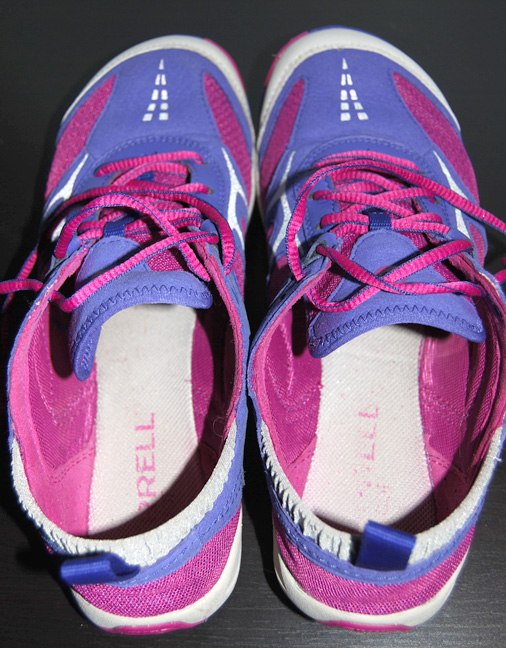 And I’m glad I did, because something interesting happened to this shoe once I got running. The mesh upper started to soften up after about a half mile (probably from sweating – which I didn’t do at work the day before), and molded to my foot. I wasn’t wearing socks so it got a little swampy in there (and I did get a little blister on one big toe), but by the end of my run the Dash Glove really did earn its name. I have been pleasantly surprised.
One interesting, if contradictory thing, about the fit of the Dash Glove is that it is rather constricting to my mid-foot. I would typically find this to be a disadvantage, given that the constriction is technically a form of support, but I admit I like the help (sshhh – don’t tell the minimalist shoe gods). Doesn’t make my foot work quite as hard and keeps the tired away longer.

But it also keeps me from wanting to recommend this shoe to a newbie minimalist runner, because I believe a beginner should run in practically nothing until they get their form down (more on this below).
I’ve put about 30 miles on these babies so far, and you can see the footprint I’ve made on them in all the pictures (I prefer taking worn-in photos – you can see brand new shoes all day long on company websites). I very much like these shoes, they are quickly becoming one of my favorites.
Minimalist vs. Barefoot
 The biggest thing to know about the Dash Gloves is that they’re actually the most shoe I have ever worn running since I went barefoot/minimalist two years ago. Most of the shoes I tend to reach for the most can be described as “slipper-like” or “kind of like a sock dunked in Plasti-Dip.”
Although they are definitely zero-drop and by anyone’s definition, absolutely a minimal shoe, the Dash Glove has a thicker, firmer sole than anything else in my closet. So to me they definitely fit more in the “minimalist shoe” category than the “barefoot shoe” one. Because of this, in my own (only slightly humble) opinion, a beginning minimalist runner might be better off first perfecting good form in a more lightly-soled shoe than the Dash Glove, because this shoe has just enough sole thickness to shield poor/heel striking form.

With that said, after two years of minimalist running experience, the thicker sole has been nothing but a relief to my feet. After about 6 or 7 miles, my feet typically start feeling a little beat up, especially on the roads where my forefoot hits the ground in the same place over and over again. Those extra millimeters of rubber between foot and pavement kept the beat-up feeling at bay for much longer. Last week’s 11-miler in these shoes was on the hilly streets of Boston, and the balls of my feet thanked me when I was done.
About six months ago I probably would have shunned such a statement. I would have proclaimed that if my feet can’t handle 7 miles of pavement, they didn’t need more shoe, they needed more training. But now I am starting to see that everything, like the Dash Glove, has its place and its moment.
And to me, the perfect place for the Merrell Dash Glove is the long road run, and it will be my shoe of choice at my next half marathon, coming up in the next few weeks.
My only question to Merrell is this: Since these shoes are basically the female equivalent of the men’s Road Gloves, why didn’t they just call them (Women’s) Road Gloves? The word “Dash” just doesn’t come to mind as easily. Just me…?


So far I have put two runs and 24 miles on my VIVOBAREFOOT Breathos. As you can see by the amount of dirt on them in the photos, they have been rugged miles – full of dirt, mud, pond scum, horse poop and heavy brush (I have a small bladder, and spend a good deal of time off the path).
Actually, that’s not true. I’ve put more like 27 miles on the Breathos. I first wore them walking my dog on the trails right by my house. I decided to wear them walking first because I wasn’t sure how they were going to fit and I didn’t want any surprises to end my next trail run abruptly. Why? Because my first thought as I took them out of the box was, “Crap. They’re kind of narrow.” I compared them to my Neo Trails. There is a definite difference. And being as sensitive to the width of shoes as I am, this could have been a problem.

Width difference: Neo Trail on left, Breatho on right.
But as soon as I wore them walking, I learned why the slight difference in width is there. The upper of the Breathos are made from a really thin mesh rather than the much thicker padded mesh of the Neo Trail, making the extra sole width unnecessary. Once I started to walk in them it all clicked: the mesh is stretchy. Stretchy mesh makes anything feel looser (just look at skinny jeans, or the Vibram SeeYa).
With that little mystery solved, it was time to take these babies out for a spin.
Like most footwear companies, VIVOBAREFOOT has a pretty consistent stylistic theme to its products. The look is classic, a bit retro and not necessarily as “sporty” as what you would typically find out there in the running shoe world. The one superficial comment that I have about Vivo’s styling in general is that most of their shoes seem to look more jeans and t-shirt than running tights and sports bra. Sparsely styled, block coloring, roomy and shapeless lasts. But that’s not so much a criticism as it is an observation.
With that said, the Breathos are the sexiest shoe in Vivo’s athletic line. At first glance they look just like everything else Vivo makes, but they’re much sleeker, leaner. They remind me of the Minimus Trail that NewBalance makes (which I can’t even get my feet into, otherwise I would have reviewed them) – rugged, curvy and perhaps a little showy. The Minimus has so far been my pick for the best looking minimalist shoe. The Breatho has that same edge. It has better lines and much more shape than some of Vivo’s other offerings, making it a shoe that’s just as beautiful as it is functional. As a consumer and a designer, I know this is extremely important to the success of a product.

The only suggestion I would make on the looks front is to add more colors. The only color ways they offer at the moment for women are pink, blue and black, while the men’s styles always seem to have more and better color choices. Really? Most men don’t spend three seconds making a color choice on their footwear, but women? We are generally much more selective and appreciate a well-rounded group of color choices. I say give us some oranges and purples and yellows. Maybe even some heather gray.
Now that I’ve gotten that out, on to the important stuff.
If you’ve read my past reviews, you probably realize that I’m not one of those really smart technical reviewers who is hyper-focused on factors like weight or the differences between shoe materials. The way I see it, my feet don’t understand weight in tenths of ounces or know what EVA rubber is. They just know how it feels to land in the shoes I put on. They feel heat and cold, crunched and roomy, security and flexibility. And when I test a new shoe, I pay much more attention to what my feet tell me than all the stats that matter to the big-time shoe reviewers.
Maybe that’s just a girl thing. Or maybe it’s why I’m not a big-time shoe reviewer.
But I digress. I took my Breathos out walking instead of running for the first time, because I really wasn’t sure how I was going to like them. But the walk was fine and I learned that what I originally thought would be a width problem was no problem at all. The only thing is, I still haven’t figured out exactly how tight to lace them. The tongue of the shoe is attached to the rest of the upper (smart move) and is made of a moderately thin and breathable wicking fabric. So if I tie them too tight I can feel the lacing on my metatarsals even though the laces are spaced out really nicely, as if that decision was made in order to add comfort. But it wasn’t comfortable at all so I loosened them, and then the minute I started running they felt way too loose. My foot was sliding around because the mesh has so much give, much more like a sock than most of the other shoes Vivo offers. So I tightened them again and they held on to my foot better. After awhile I didn’t feel the laces as much anymore, but I still kept futzing with them unconsciously every couple of miles during my 14 miler the other day. This could have been a downfall of my wide feet, maybe most people with normal feet won’t have the same issue. but I’m curious to find out if they do.

Other than that I definitely liked the Breatho. I found them to be slick, form-fitting and true to size. Also a whole lot cooler (temperature-wise) to wear than the Neo Trail. And because they are so light, I consider the Breatho and the Neo Trail to be perfect summer and winter companions.
Side note: I have a tendency to run right through puddles rather than jumping over them (unlike normal people with brains). And since it’s still kind of chilly outside in mid-March, the Breathos didn’t dry right away and my toes got kind of cold afterward. Which will make them perfect for the summer! And they were dry in an hour or so – unlike the Neo Trails, which kept me warmer when wet but took several hours to dry.
I will say that I’ve resorted to keeping the insoles in these shoes, because I just don’t like the way the lugs feel on the balls of my feet and my toes. A soft sole equals more sensitivity, I guess. Gotta take the good with the bad.

I like to get dirty when I run.
Because they use the same sole, the Breatho’s trail performance is the same as the Neo Trail. The 4.5mm directional lugs cut through dirt, rocks and sand just as well, and I was pretty happy with that. I really, really like Vivo’s trail soles. I feel extremely confident and sure-footed on them. And I’m such a huge fan of the super flexibility – even though it gives up some protection, the way it curves around the terrain like a bare foot means the difference between a strong trail run and a bummer ankle sprain. Even if I have to take an occasional sharp rock to the arch of my foot.
Because I am training for a hilly 50k this spring, I have been tackling as many hills as I can find on my long runs. One thing I always hated about downhill running (besides my tendency to take them too fast and anger my IT band) was that my feet would always slip on rolling rocks and sand. In the Breatho I might still slip on the worst stuff, but it takes a lot more before it happens.
I’m not entirely sure why, but the Breatho Trail is priced lower than almost the entire VIVOBAREFOOT shoe line. Maybe it’s that the lighter materials aren’t expected to last, or maybe Vivo decided to go easy on the price of this shoe in anticipation of its popularity. Either way I think it’s a decent price, and so far as I can see, worth it. They seem to be well constructed, for the most part.
The one thing I did notice happened to my particular pair is that after only a few wears there is some loosening of the stitching on the heel tag. I didn’t notice it right away, but I realized it after I took this picture.
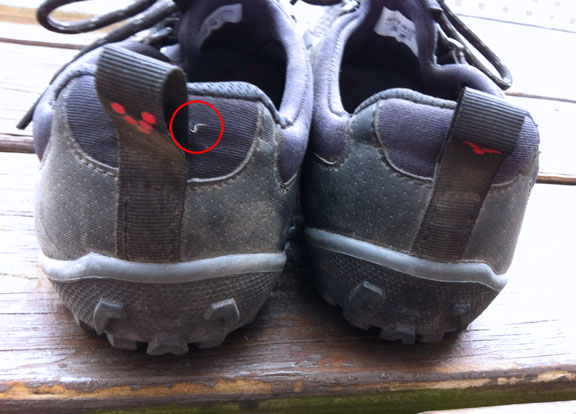
I don’t remember using the tab to pull on the shoe, so I’m not sure how it even happened. Could have happened in production. But it looks like a surface flaw that probably won’t have any detrimental effects on the rest of the shoe, unless it starts to pull away at the fabric on the heel. But I’ll definitely check back in after a few hundred miles on these, and let you know how they last.
And as a special addition to today’s review, I am adding some photos of my latest trail run in my Breatho Trails. Know why? Because these shoes got me through 14 MILES this weekend – my longest run. Ever. That’s worthy of a little celebration, don’t ya think?

Most of this trail is regrettably flat, but there are some hills. Unfortunately for you, I didn’t have the wherewithal to take photos while I was figuring out the hills.

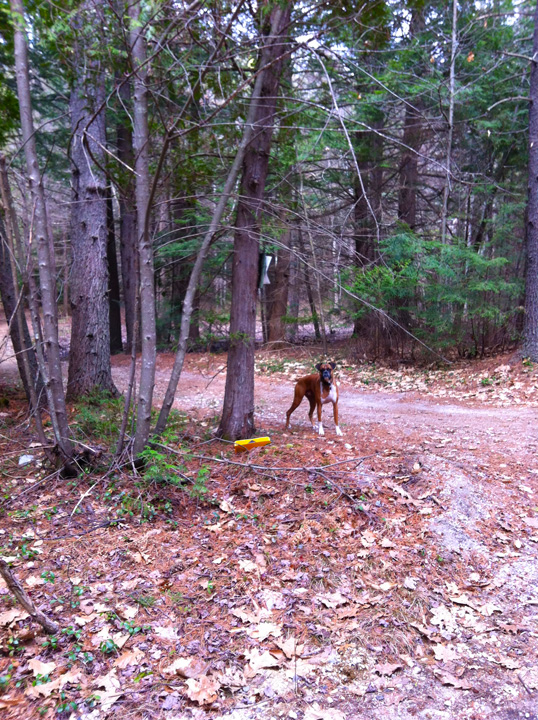
Oscar is an excellent trail running partner. He’s always up ahead with this look like “well, are you coming or not?” Best dog in the world.


I bought this pair of SeeYa‘s myself because I wanted to try them out, right now, and didn’t want to wait for Vibram’s PR crew to respond to me. They were released earlier this month and most of the running stores in my area that reliably stock minimalist shoes won’t be carrying these for at least another month. Also I only found a couple online reviews of these so far, and I know when I am thinking about investing in a new running shoe I want to hear at least 4 or 5 different opinions. So I figured I’d take this opportunity to help out my fellow minimalist runners by adding to the wealth of early reviews on the SeeYa. Yes I know, I’m more like Mother Theresa every day.
Anyway, so here’s the Barefoot Monologues first impressions the Vibram FiveFingers SeeYa.
Looks and Stats

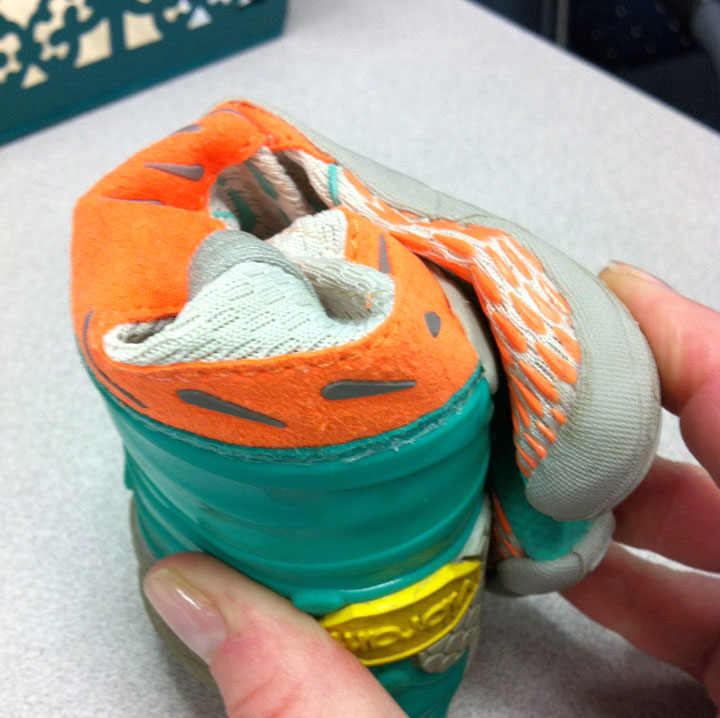
SeeYa fruit rollup

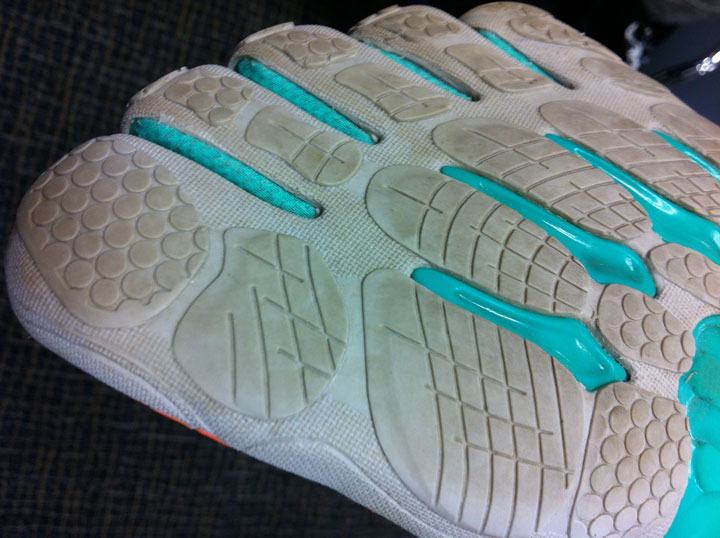
Weight
These babies are just incredibly light. There’s nothing to them. When I say I feel like I’m not wearing anything, I mean I feel like I’m not wearing anything. The stretch mesh is so stretchy that it puts very little tension on my foot. It practically disappears when I’m in motion, all I can feel is the collar of the shoe at the ankle opening and the rubber soles clinging to the bottom of my feet. This is a huge positive for me because I have extremely wide feet and everything is tight. The super-stretchy fabric of the upper seems like it would be quite accommodating to various foot widths, and the strap closure can be adjusted for a precise fit.
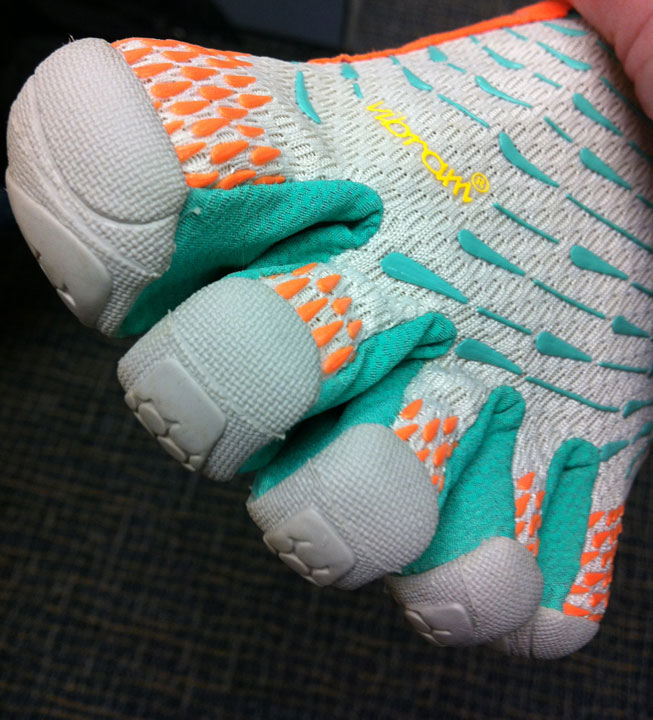 The SeeYa is very light. But it can sometimes be difficult to tell really how light a shoe is when it’s on your foot. So just to be sure my mind wasn’t playing tricks on me, at the store I actually tried on one Bikila (my long-time favorite) and one SeeYa and walked/ran around for a few minutes. The guys at the store probably thought I was a total ass – but it was all for the love of my readers! When I did this exercise I was astounded by the difference. The Bikila feels padded and lifted in comparison to the SeeYa. In essence, it is just a heck of a lot more shoe than the SeeYa. That’s not a jab to the Bikila either – I still love the comfy-couch factor of the Bikila, and my size 39 in them still only weighs in at just under 5 ounces per shoe. But the SeeYa seems to be built for performance, with extra attention paid to that all-important ground feel.
Fit and Performance
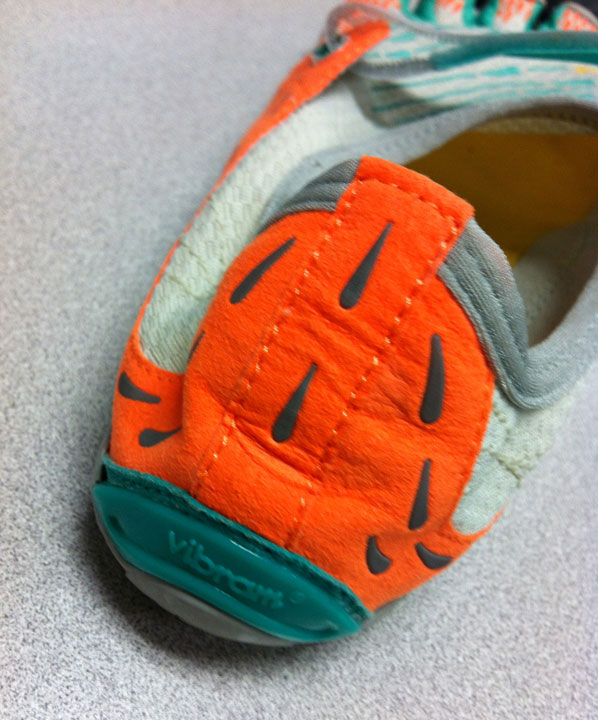 The fit was a bit strange and misleading, I’ll admit. My first impression wasn’t great when I tried them on at the store. I was sure I was going to hate two things about the fit: the heel and the toe. In both places, the meeting points of the super soft stretch mesh and the (relatively speaking) stiffer TPU rubber caused me some feel-weirdness. There is a short, rounded lip of rubber at the heel, and more rubber on the toe-guards that travel up the front of the toes. I could feel the rubber brushing the top of my big toe right away (even though they are by no means too small), and the mesh at the heel immediately scrunched down and caused a bunching-up of the fabric there. Both things seemed way uncomfortable to me while I was walking around at the store, and I hoped it would either work itself out after some wear or I could solve it by wearing socks. Funny thing? The second I started running in them the weird feeling went away, both in the toes and heel. I actually forgot that I was worried about the problem, that is until I was walking around the office in them later, on my way to the showers. For this reason I will probably only ever use these shoes for running.

Check out the heel – you can see how the soft fabric bunches up.
In another review I read, there was a complaint about the strap closure digging in to the reviewer’s foot, so I was anticipating a problem there. Especially because the strap, although it’s really thin and light, is made of a more rigid fabric than the upper and I could see it becoming an issue. But I typically keep the straps loose on my Vibrams anyway, and so far I have yet to feel it at all, even when I go sockless.
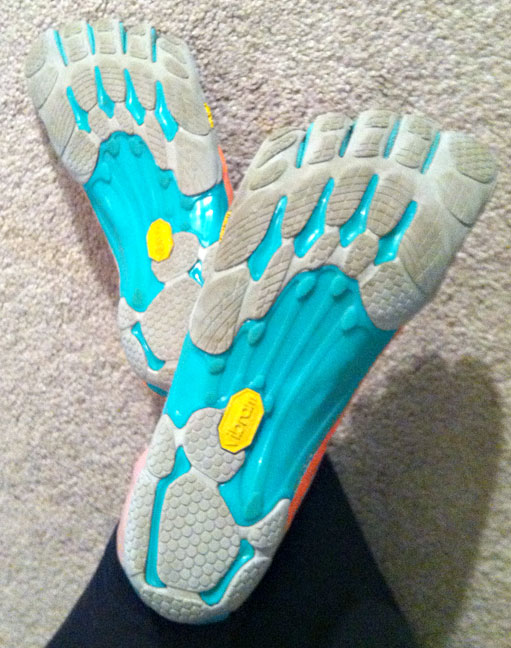
Alien feet
As far as general performance, I am happy so far. I ran some hill repeats in these, and I did notice my heel sliding around in them a bit when I was really digging in to my stride. This was a fairly cool day at 58 degrees. Since the uppers are made of such airy mesh, this shoe is naturally going to be great for summer running – but I wonder how much more sliding will happen when the days (and my feet) warm up.
Final Thoughts
So far I really enjoy the SeeYa, and I am pretty confident that it could become my favorite FiveFingers model. I have begun to notice that Vibram is starting to go the way of developing shoes for certain purposes, for instance this one for roads, and the Spyridon for trails. Some people don’t like this new direction, but I think it’s good, and it’s about time. In my opinion it’s smarter to have a separate thought process for each type of terrain and maximize the usefulness of its corresponding footwear, rather than try to come up with a jack-of-all-trades shoe that masters none (cough…Bikila…cough, cough).
But this isn’t going to be my final word on these. I want to write a follow-up review after a hundred miles or more. The biggest reason is because they’re so light and the sole is so thin, I think it will be important to understand how the SeeYa holds up against the other FiveFingers offerings. After two years of minimalist running I know that I have pretty good form, but after only a few runs in these I’m already seeing a bit of wear in the usual landing spots of the sole. The durability of this shoe might (or might not) be its biggest weakness, only in that if it dies much earlier the rest of Vibram’s $100 lineup, its perceived value could take a nosedive. Despite its obvious technical merits, I still cringed a little at the price vs. the amount of durable materials. I look forward to seeing how this shoe holds up on the roads this summer.

When my contact at Vivo asked me what shoe I wanted to try for my next review, I told her that I’d been looking for something that would handle the trails during a New England winter. Last year I was forced to the roads for all my training runs because taking my Bikilas to the icy trails was like running on ceramic floors with two bars of soap strapped to my feet (so are the standard Neos, by the way…I found that out the hard way this afternoon). She shipped me this pair of Neo Trails.

Sorry these are all muddy post-run photos. Forgot to shoot them before trying them out.
Not exactly my normal choice of colors, but hey, they were free. No arguing with that. And they actually looked kind of rugged and outdoorsy like I would picture a traditional trail shoe looking, so I tried the suckers on. They fit exactly like my Neos (no surprise there), with their wide toe box and soft, slipper-like last. The only big differences between the Neo and the Neo Trail are the lock-lacing system and the 5mm lugs. Of course they’re a little heavier (and also a bit stiffer, although not as stiff to me as the Merrell Pace Gloves), but I’m sure I was more grateful for the aggressive, grippy sole than I was mournful of a lighter shoe.
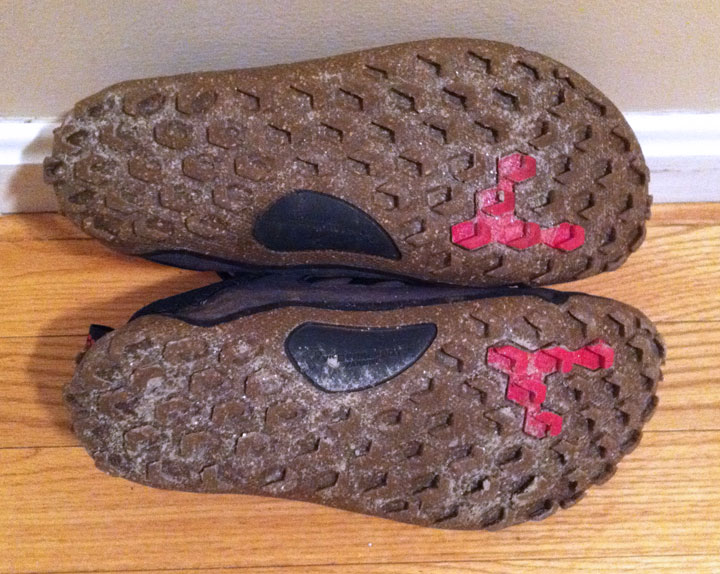

Pretty flexible, for aggressive trail shoes.

Side by side, with my Neos.
The Neo Trail, like all of Vivo’s great minimalist running shoe lineup, is made from 100% vegan materials and constructed soundly, as always. Although I chose to wear socks in mine (it is winter, after all), there is a nice soft inner lining so you could go without them. Also it comes with the usual removable insole, but I left mine in for the bit of extra padding I might need for the rocky trails ahead.
It seems almost serendipitous that I got these shoes when I did, because only a few days before I had, on a whim, signed up for a 50k trail race in May. That means for the next four months I’ll have to put a lot more trail time into my long runs. I had two rather life-changing long runs with these shoes, and I will have to say that they gave me everything I needed to feel confident about that trail race.
 Running in snow and ice is one of my biggest fears, especially because I have accident-prone ankles. But my last run in these, in particular, settled all my fears about it. It was eight miles through brand new trails for me. It was 1/3 ice, 1/3 snow and 1/3 bare earth (rocks and sand). Two miles in, knee-deep lake water had crept up onto the path. All of this gave me a fantastic obstacle course to test out the Neo Trails.
Rocks and sand were no problem for this shoe, of course. It was built for that sort of thing. I glided over the trail bed, hardly feeling the sharp rocks beneath the puncture-proof sole. The lugs did their job of digging into the earth and forming a nice barrier between it and my foot. And because the sole is so pliable, the shoe didn’t roll over every time I landed funny on a rock, and take my ankle with it – it simply curved around the uneven ground, letting my foot remain strong and my body balanced naturally. This feature, intended or not, may be the best thing about this shoe for me.
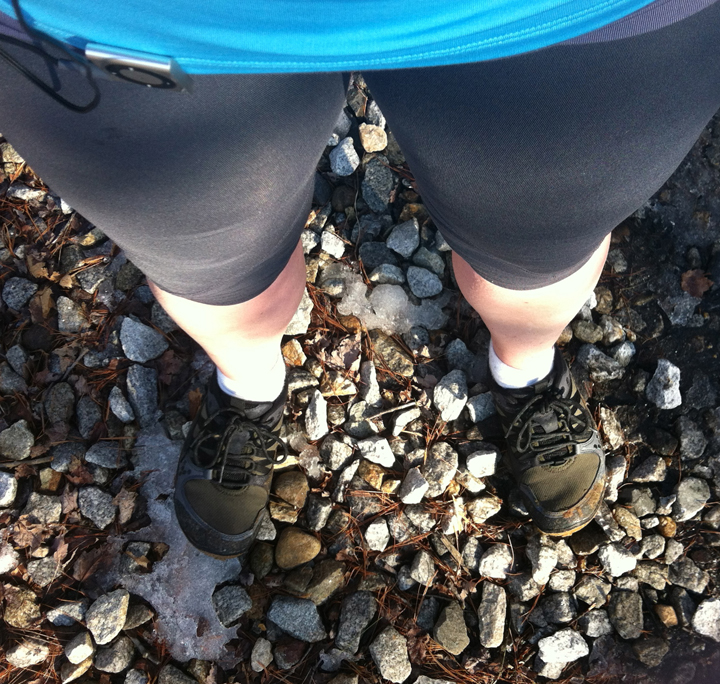
These shoes match the rocks on the trail. It’s like my feet disappeared!
The Neo Trail’s grip on snow was faultless. A shoe like this almost begs for hard-packed trail snow. I felt strong and confident running those miles of snow, some icy, some of it crunchy with old footsteps. The hydrophobic mesh and microfiber uppers stayed dryer than many shoes, and relatively warm. Well, that is until I dunked them into 40-degree water. Twice.
But after a brief period of frigid, squishy enjoyment, they stayed kinda wet but they warmed more than I thought they would and kept me from getting frostbite. Bravo on that front – I had failed to choose my wool Injinji’s that day, and was just wearing regular socks. I do suspect though, that the materials in this shoe might be way too hot for summer trail runs. I hate having hot feet. I hope Vivo will come out with a version of these that have a more breathable upper for hot days.
Even the ice was nice. This shoe didn’t let me fall on my ass! Not even once. There was a footfall here and there that indeed brought on a brief slide, but I mean…we were talking about sheer ice here, hard as a hockey rink and bumpy as hell, with absolutely nothing to grip. In my other running shoes, I might have given up and resorted to scooting past those bad parts on my bum. The Neo Trails did a job above and beyond what I expected out of them on the ice. Superb.
But for all its ruggedness, I am fascinated by the fact that the Neo Trail still feels like a minimalist shoe. Although I didn’t feel any of the usual sharp rock bites (gotta love those, ouch!), I still felt the ground. The soft, flexible sole is really the key here, I think. It lets you feel the texture of whatever is underfoot. I could distinctly feel the difference between the various textures of the trail I was on, and of the road (where I briefly tried them). It’s something that not every minimalist shoe company gets right. The only downside to this softness is that I could also feel the lugs of the shoes under the balls of my feet, particularly on harder surfaces like ice and pavement (although I’m not sure why anyone would use them on pavement). It is a drawback to the demand for a trail shoe that is also minimalist. But its a drawback I can take and still call these a truly fantastic trail running shoe, minimalist or not.
Final Thoughts
The VIVOBAREFOOT Neo Trail is an excellent all-around trail running shoe. It is rugged and protective while remaining exceptionally light and pliable for its genre. Its heavy lugged sole is aggressive enough to provide grip during all trail situations, while still providing an acceptable level of ground-perception that a minimalist runner needs to remain strong…and upright. The Neo Trail will easily become my favorite trail shoe (despite mine’s decidedly masculine color) and will most likely come with me to the 50k in May, if it’s not too hot out.
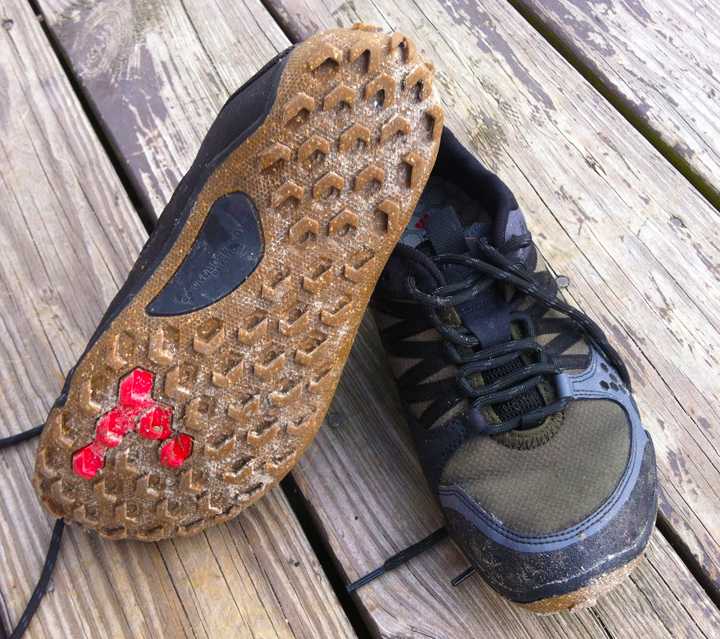
Soaking wet, after my wet 8-miler.
Today I’m reviewing a lovely pair of Feet that were generously sent to me by a very small company called My Two Parents, a division of Mother Nature Company, Inc. I was delighted when they arrived, as they have become an excellent running tool ever since.

Looks
The pair of Feet I received were a women’s size 8, or EU 38. They are light in color, almost pasty, and also a little bit bony with short stubby toes and an exceptionally wide toe box. The soles are smooth and pink, with a high arch. But they look strong overall so I think they can handle most of the terrain I typically run on. The toenails aren’t too pretty, though, looks like they haven’t been through a pedicure in awhile. There’s some chipped polish on most of the toes. But that’s okay, I checked with the company and it turns out it’s only a cosmetic defect that won’t affect overall performance.
Weight
As far as weight goes for minimalist footwear, Feet are the lightest things on the planet. In fact, you can’t even weigh them because of how close they fit with your body, and their difficulty to detach and be weighed separately. But I can guarantee you that no shoe, no sandal and no FiveFinger can match Feet’s sheer invisibility in weight.
Construction and Durability
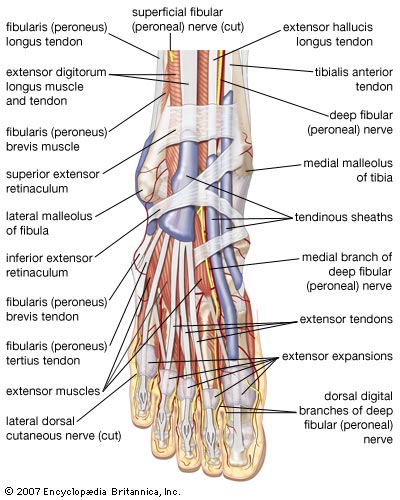 Feet are made up of 26 tiny bones, 33 mobile joints, layers of tendons and muscles intrinsic to helping you run. They also have several layers of skin that hold everything together flawlessly, without any stitching or lacing to fuss over. Feet are, without a doubt, the most complex and beautiful running tools out there, and yet the most simple. They’ve got stellar cushioning capabilities, in this case called the Arch System. Pronation control? You don’t even need it! Feet can allow you to run beautifully no matter what biomechanics flaw the pimply sales guy at your local running store tells you that you have (they don’t like Feet too much over there). Furthermore, you don’t have a mileage limit on these babies, meaning there’s no need to shell out hundreds every couple of months to keep your running “fresh.” You only ever need one pair. By my count, that’s Mother Nature: 3 Nike: 0.
Unlike all the other footwear brands, the more you put Feet through, the stronger and tougher they get. If you overdo it and mess them up, they’ll get better after a while and let you abuse them again. They’re waterproof, highly washable and dry almost instantly. There are no seams on the inside, so no chafing. You can save some BodyGlide there. And you don’t need to wear socks inside them either, Injinji or otherwise. Very cost-effective.
Performance
I love to take my pair of Feet out for runs on their own during mild weather. The ground feel is exceptional. The best, actually. There is zero loss of prioperception on trails, and they are most definitely your best choice of footwear when it comes to learning or correcting your running form. My only complaint is that the soles don’t come strong enough at first to put up with highly textured ground…for that you’ve got to wear them in a bit before you stop getting ouchies. Kind of like wearing in a good pair of leather flats. Also they’re arguably not all that great during tough New England winters, mine especially – the toes go white when it’s too chilly (but that might just be my pair – every one is different). Some crazy fools and nut bags do go out there in the snow with Feet, though, and to each his own. Shoes as tools, right?
Feet are not great for every situation, but that’s okay because no footwear is. Have no fear, you can still wear your Feet under a great pair of minimalist shoes, like Vibram FiveFingers or VivoBarefoot footwear. As long as the shoes don’t prop up the heel or mess with ground feel too much, Feet can still do their job. They’re pretty amazing that way.
Conclusion
Feet are exceptional, unprecedented footwear, and every runner should own a pair. I take mine with me during every run…heck, I never leave home without them. They are your best running tool, right after, of course, supportive underwear and sports bras.
Hey everyone!
First I’d like to thank everyone who participated in the giveaway for reading my review and helping to spread the word about this tasty health food, Paleonola. I hope everyone who read this will try some.
This morning I counted up all the entries (31 total) and assigned numbers to each one, by the order they were entered. Then I employed the Random Number Generator to pick my winner for me. And that winner is:
KIRBAMBINO!
Congrats to Kirbambino! Please email me at trleigh32@gmail.com with your mailing information. I will have the peeps at Paleonola rush out your free granola this week.
Thanks again everyone, this has been a lot of fun!
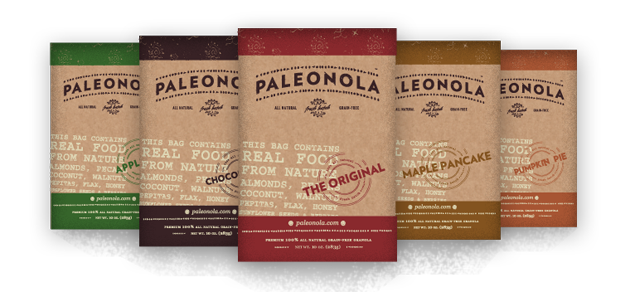
You might be wondering why I’m writing a review for something that has the word “Paleo” in it. No, I’m not a Paleo eater. I’m not a vegetarian or vegan, either. I like to think of myself as a vegan PLUS a Paleo, because I eat just about everything. This fact could account for some of my gripes about my figure but hey….I love all food (thank God I also love exercise!). I’m not the kind of person who enjoys controlling and limiting the types of foods I eat, nor do I exactly believe that we should. Let me clarify that: none of us should be eating fried chicken every day, or McDonald’s….well, ever.
But my Paleo and vegan friends are very healthy people, and they are very much alike, because they both choose whole foods and don’t eat a lot of crap. So even though I don’t believe in axing either meat or grains from my life, the healthier eating is motivating, and I have taken some notes from all of these folks in my daily menu. But I sort of believe that humans evolved to eat whatever they were able to kill or gather, and that included meat, vegetables, nuts, grains, etc. It’s the homogenized, industrialized, antibiotic-fed, corn-filled, sugared and salted, genetically modified food nowadays that I disagree with, and it’s those kinds of foods that I try to limit in my diet as much as I can.
Okay enough about me, what I came here to talk about is this great product called Paleonola. The first time I tried it was after the NYC Barefoot Run (has anyone else noticed that event has somehow seeped into my life in about 100 different ways?). As part of the swag bag every participant received, there was a little sample-sized packet of Paleonola. The name seemed a little clunky to me at first, but I guess it made sense: Paleo-style granola, right? So I brought it home and threw some in my soy yogurt (from a local organic dairy farm) the next day.
Holy crap, this stuff is good.
So good, in fact, that I wrote to the company to tell them how much I loved it, and they graciously sent me a sample packet of each one of their flavors to try.
I’m a granola fan, but I usually avoid the greasy, high-carb stuff they sell at the supermarket and just put some raw nuts in my yogurt (not too many raw almonds though, they make my face itch). Especially when I’m on a good-eating kick, I feel guilty eating a handful of regular granola. Paleonola has no grains in it. No hydrogenated oils, no preservatives, no corn syrup, low-carb and totally vegan. The Original flavor is made with just some ground up nuts, coconut, and fruit. It’s got that amazingly satisfying crunchiness, with a little bit of gooey-yummy flavor. Positively addicting.
Paleonola offers five flavors: The Original, Chocolate Fix, Maple Pancake, Apple Pie and Pumpkin Pie. I usually prefer options of the plain variety because I’m not really a fan of taking something that works and adding weird flavors to it. It often seems trite and gimmicky to me. But in Paleonola world, for example, Apple Pie is not “apple pie #6” flavored. Thankfully, it’s much subtler than that. There’s just little bits of dried apple and some spices in it. Unlike most products on the supermarket shelves, the additional flavors don’t go overboard, so if you like the original, you’ll like the other flavors too. The only one that I’m not as much into is the Chocolate Fix. I know, go figure – I’m like the Chocolate Queen. I think it’s just me, though – when I’m eating granola, I’m not in the mindset for chocolate. But I bet it’d be great in a baking recipe. If I was any kind of baker (which I’m not) I’d probably be able to make a hundred delicious recipes out of this stuff.
I can only think of one drawback to this product: although I am a huge fan of Paleonola I’m not as huge a fan of the price ($8.99 for 10 oz. bag). We are all so used to paying super low prices, aren’t we? It’s because we are typically buying cheap foodstuffs that use cheap ingredients (have you heard they put sawdust in some food? Yuck!). But like my Grampa always told me, “you get what you pay for.” Paleonola is truly a high quality product. And considering the top-notch natural ingredients, the price, while seemingly high, is actually pretty fair. Also they do offer coupons if you sign up for their newsletter, and they have subscriptions to receive Paleonola monthly, or to give as a gift (an awesome gift for the Paleo in your life!)
Paleonola has been growing as a company, and in September they announced their first appearance in some Whole Foods stores near their home town of Cranston, Rhode Island. You can follow the latest Paleonola news on their blog, and find them on Facebook and Twitter.

Now it’s time for the first ever Barefoot Monologues giveaway!
Want to try some of the best granola in the world? The lovely folks at Paleonola have offered to send an entire Variety Pack of each flavor to one lucky reader. There are many ways to enter (1 entry for each action item):
Post a comment for each entry! The giveaway will be open through Sunday, December 18th. On that day I will let the random generator pick the winner for me, and I will announce him or her on my blog. Good luck and thanks for participating!

Let me just start off by saying that I’m not much of a huarache person, or maybe not yet, who knows. But my relationship with huaraches, and Invisible Shoes specifically, started at the NYC Barefoot Run back in September. Most of the folks I was hanging out with were wearing some version of a running sandal half the weekend, and except for one time at the Hotel Del in Coronado, CA, the previous December (and I wish I’d stopped to see if he was someone I actually know), I’d never even seen a pair of huaraches on someone before. But during the trip I had a conversation with Steve Sashen of Invisible Shoes, and somehow he managed to convince me that I needed a pair of huaraches. Good salesmanship, I suppose. And a good discount code, too.
So in early October I purchased the 6mm Contact do-it-yourself kit, because I figured that since I’m an art person I must therefore be good at constructing my own running sandals. I guess I must have blocked out all the botched towel holders and teetering curtain hangings I’ve committed in the past, due to my utter lack of construction skill and patience. Alas, what came in the mail was two flat pieces of rubber, two long black tie strings and a link to some videos on how to put everything together. It looked so fun that I immediately ran upstairs to the computer room and got started.
The Construction
 I would say that in the progress of my life there have been very few occasions when I have felt truly stupid, and this was one of them. Now, before you start to think that maybe making Invisible shoes huaraches is difficult, let me alleviate your mind by saying it’s actually not. It’s very easy if you possess patience and the correct tools. The soles come with two holes punched into them, one hole that you need to make yourself (between your first and second toes) and a lace that is a little wider than the pre-made holes. Therefore you need to employ a hollow bit (which I don’t have) or a leather punch/awl (which I also don’t have). And if you don’t have any of these items, you should go buy or borrow one from your neighbor (which I didn’t do). Don’t use scissors and an Exacto knife (which I did do).
At this point I’m sure I probably have 20 skilled huarache-lovers rolling their huarache-wearing eyes at me, but what’s done is done. I played the video of Steve and his lovely 70’s-inspired curly locks about 18 times, memorizing each step and doing my best to recreate it with my shoddy tools. I found that the sole didn’t need to be trimmed at all to be an exact fit to my super wide feet (this being the only sign in my genetic code that I’m 1/8 Native American – thanks, Dad’s pasty-white skin), which was good since I probably would have screwed that up anyway. But I had the worst time trying to get the lace through the pre-made holes on the sides – it probably would have been easier with the thinner 4mm Connect kit – but once I got them through, the lacing part was fun. I chose the “slip on” tie method because it looked the most comfortable, and it took me several rounds of watching the “tying” video before I got the tightness right.
The whole process took me 70 minutes, two Exacto blades, half the fuel in a cigarette lighter and 30 F-bombs, but when I was done they looked as awesome as the ones on the feet of all the sandal-wearing hotties at the NYC Barefoot Run. Mostly because the laces hid all the little knife slips that marred the surface of the soles.
By the way, if you suspect you are as much of an idiot as me, I might suggest getting a pair of Custom Made invisible shoes.
The Cool Factor
Like I said above, I’m not much of a huarache runner. I’m not much of a barefoot runner, either. I love the idea of running totally barefoot, and I feel like a badass when I am doing it. I can even be caught taking off my shoes on a mild day, on an interesting ground surface, or when I feel I really need to examine something in my running form, but it’s not my default. I think it might be the same story with huaraches. With that said, running sandals, especially the Invisible Shoes brand, have a huge cool factor in the barefoot/minimalist running world, and in my mind, which made them attractive to me. They are also the lightest and most reasonably-priced viable “shoe” on the market, and everybody who is worth their salt is running ultras in them. So that cool factor definitely draws me to the look and performance of Invisible Shoes.
Also, if you were inspired like me to become a minimalist runner because of the ultimate kings and queens of cool – the Tarahumara tribe of runners in northwestern Mexico – you should probably at least try out a pair of huaraches. And the Invisible Shoes look and feel a lot like the ones the Tarahumara wear, so they seem authentic and may even fool you, like they did me, into thinking you’re an awesome runner. I mean, I will admit that when I started my first run in mine I felt like a god-damn rock star.
The Run
By the time I’d purchased, received and constructed my very own pair of Invisible Shoes, it was already too cold for me to run in them. Late October dumped an unheard-of foot and a half of snow on New England, trashing electrical wires and emptying supermarkets all across the area. Then Thanksgiving came and it was 60 degrees outside. Rather than scratching my head at the insane weather pattern, I slipped on my Invisible Shoes for a nice three mile lunch-break run around a local pond.
Keep in mind, not only was this my first run in a pair of Invisible shoes, it was my first run ever in sandals. So this review is more about my experience wearing running sandals than it is a comparison between brands.
 Like I mentioned above I don’t really run barefoot a lot, which means I don’t have very tough soles. I think this might have been a down-side for me with these shoes, because the 6mm sole, while not really any thinner than those on my trusty Bikilas, let me feel…..EVERYTHING. Don’t get me wrong, ground-feel like this is a great thing, but man did these shoes teach me a few things about what I lack as a “barefoot” runner. A good section of the path around the pond is an unpaved rock trail. I think I stepped on about a dozen really sharp rocks and every one of them made me want to swear loudly (but I couldn’t because there were too many old couples sitting on benches within earshot). I can’t put my finger on what the sandals lack that my Bikilas have, but I don’t think I’ll take these out again on such rocky terrain. Luckily the path also had sections of paved road, concrete, grass and hard-packed sand (it’s quite the cornucopia of surfaces, now that I think about it), and the sandals handled those just fine for me.
Big surprising plus to the fit of these shoes: I absolutely expected the nylon laces to bite into my feet and ankles while running. In fact I panicked a little when I realized I forgot the BodyGlide I’d meant to slather all over my feet. I mean, the laces don’t appear to be designed for comfort or stretchiness like some other brands. But to my relief the laces didn’t cause one single blister or sore spot on any part of my foot. The soles of the sandals also didn’t get caught on cracks in the road or cause me to stub my toe on tree roots, which I also feared. For the most part they acted exactly like a very light, very minimalist shoe (as advertised).
I only had one issue during my run, and it was all in my left foot. Again, the shoes reminded me that I still have imperfect form. Over the first quarter mile I kept getting a sharp pain on my second toe because of the lump of knotted lace end on the bottom of the sole. After cursing the whole idea of huaraches for about three minutes, I realized I was scrunching the toes in my left foot and pushing off. Oops. That was an easy fix and it was fine afterward, but I noticed my feet were flopping into the front of the shoe a bit, and my normally silent footfalls were making a “flop-THWAP, flop-THWAP” sound. I stopped to adjust the laces but they were pretty tight on my feet already and I didn’t want to over-tighten them. So I kept going, hoping that my feet would swell up a bit after awhile and fill out the extra space.
By the time I finished my three miles I had a hot spot near my big toe on the ball of my left foot. It’s the only place I’ve ever sustained reoccurring blisters since I started barefoot running, so I know it’s a lacking in my form (my left foot always stays on the ground too long). But it’s a lacking I have worked on for so long without success that I’ve come to think it’s more to do with some musculoskeletal imbalance that I have yet to identify. The Invisible Shoes highlight this imperfection. So I would say the big plus of these sandals is that, like barefoot, they don’t let you get away with shitty form of any kind. Because of that, this would be an excellent training shoe for a beginner minimalist runner who doesn’t want to go completely barefoot. For this purpose they would be much better than, say, a pair of Vibrams.
The Public Reaction
I want to include a commentary on the public reaction I got from running in my Invisible Shoes. A couple of years ago, the Vibram FiveFinger was the favorite “weird, creepy running shoe” of the barefoot running illiterate. But nowadays I no longer even get a second glance if I wear my Classics out to the mall. But if you ever decide you want to renew your bounty of weird looks in 2011, go for a run around the ‘burbs of Boston in a pair of Invisible Shoes. It’s funny, too, because I don’t think people would think much of me walking in these sandals, they don’t look much different from what’s in style these days.

The lake near my work.
Anyway, it was a beautiful 65 degree afternoon when I ran in these, so there were a ton of old and young couples walking together, moms pushing strollers, dog walkers, executives talking business while exercising on their lunch breaks, speed walkers in matching sweat suits, and a couple of shod runners (with horrible form, I might add). I got a weird look from each and every person I ran by. One middle-aged lady actually pulled her Portuguese Water Dog closer to her for protection when she saw me coming. Halfway through my run two power walkers whom I had lapped twice stopped me to yell out “Where are your sneakers (pronounced ‘sneak-as’)?” I just shrugged my shoulders and answered, “Oh, I lost them.” They returned to their walk, completely perplexed, and I turned away quickly so they wouldn’t see my grin.
Final Thoughts
Although I do think I like my Invisible Shoes, I still have mixed feelings about huaraches overall. With that said, this review comes after only one test run, and at a time in the year that doesn’t afford me the chance to do a whole lot of running in sandals.

My dirty feet after the run.
The pros for me are the extremely light sole and comfortable laces that offer versatile tying methods. I also appreciate their very authentic Tarahumara huarache feel, which I find many other running sandal brands lack.
What I need to get used to is their inability to cover up any flaws in form (which is actually a plus, but I’m being whiny about it), and I need to perfect the tightness of the lacing to prevent the flop-THWAP problem. Apparently, the sweet spot is somewhere between comfortable and too tight.
So even though I had a lot to say about my first run in these shoes, I plan to revisit them again when the weather warms up this spring.
How do you like your Invisible Shoes? I’d love to hear.
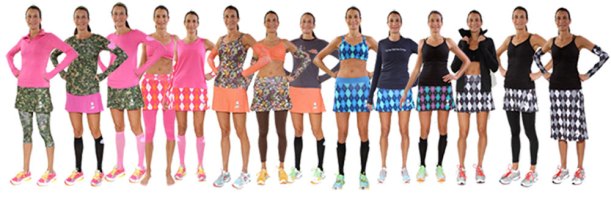
Hey ladies (and some guys)! If you don’t have a running skirt, you’re missing out! The lovely owners of RunningSkirts.com generously gave me one of their awesome skirts to try out, and I reviewed it for Active.com. Needless to say, I loved it!

 Barefoot Monologues